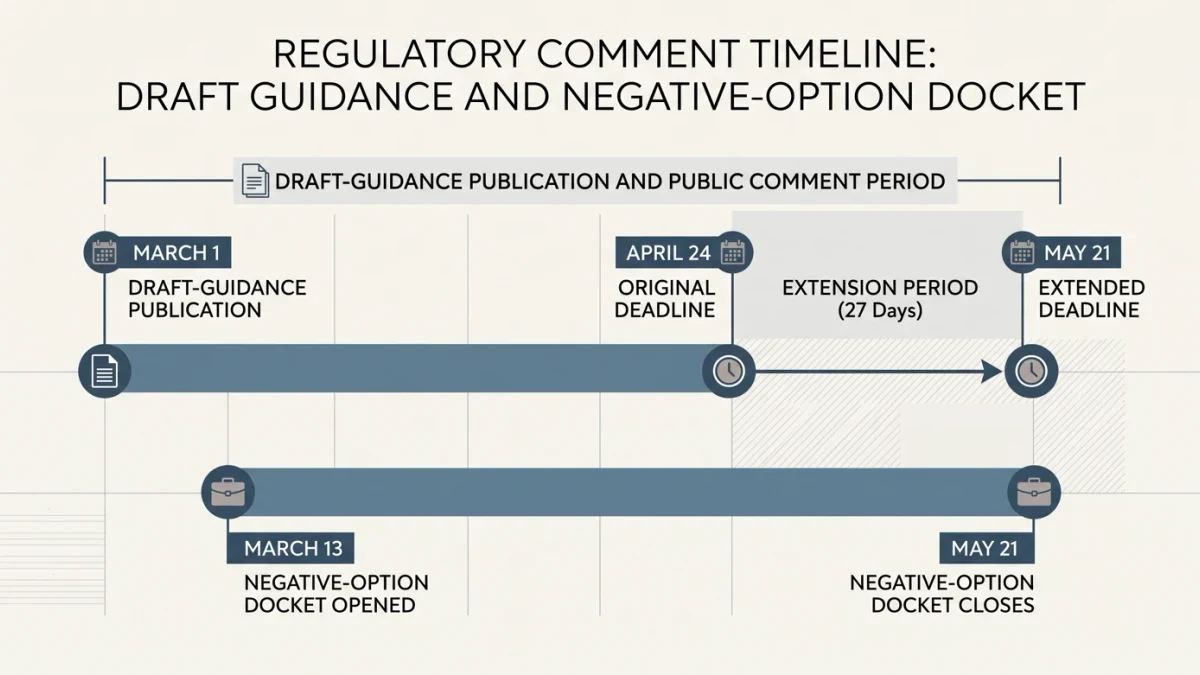
FDA's public comment window on its proposed Expedited IND pilot program closes July 22, 2026, per a Federal Register notice published June 24. The docket follows a stretch in which clinical holds hit three high-profile gene therapy programs, including both REGENXBIO MPS trials, per the company's January 28 announcement.
What is FDA actually proposing?
The agency is seeking input on a pilot that would establish a network of "Qualified Research Institutions" — academic medical centers, healthcare networks, contract research organizations, regulatory advisors, or other third-party review organizations — that would partner with sponsors to develop and review protocols for first-in-human trials intended for an IND submission. The stated aim, in the notice's own summary language, is "to shorten the time it takes from drug identification to first-in-human (FIH) study, while protecting clinical trial participants."
The comment window itself is the near-term calendar item: written comments must be received by July 22, 2026. What FDA does with the input — whether the pilot launches, with how many sponsor-institution pairs, and under what eligibility terms — is not yet disclosed. The proposal speaks to a widely reported industry pattern in which early-stage sponsors route first-in-human studies outside the United States, where initiation can be faster.
Why does the proposal land in a year of gene therapy holds?
The backdrop is a series of FDA holds in gene editing and gene transfer. On October 29, 2025, FDA placed clinical holds on both of Intellia's Phase 3 MAGNITUDE trials of nexiguran ziclumeran after a patient in the cardiomyopathy trial experienced a grade 4 case of liver transaminase elevation and increased total bilirubin, as reported by NeurologyLive. The hold on the polyneuropathy trial, MAGNITUDE-2, was lifted by January 28, 2026 after agreed liver-test monitoring changes, while the ATTR-CM hold remained in effect at that time.
Days later, REGENXBIO disclosed its own holds. Per the company's press release, FDA placed a clinical hold on RGX-111 for MPS I "following preliminary analysis of a single case of neoplasm (intraventricular CNS tumor) in a participant treated in its Phase I/II study," and also placed a hold on RGX-121 for MPS II, "citing the similarities in products, study populations, and shared risk between the clinical studies." The company added that it "has not yet received the full clinical hold letter and awaits additional details from the FDA."
How does a hold get resolved?
Under FDA's procedures, a clinical hold is an order to delay a proposed investigation or suspend an ongoing one, and may be imposed when subjects "are or would be exposed to an unreasonable and significant risk of illness or injury." Per the agency's clinical hold procedures page, FDA will attempt to discuss and resolve the matter before issuing a hold absent immediate serious risk, sends a written explanation within 30 days, and commits to reviewing a sponsor's complete response within 30 calendar days. The Intellia timeline followed that rhythm: an October hold, agreed monitoring modifications, and a partial lift within a quarter.
For sponsors, the policy stakes cut both ways. Faster first-in-human initiation is the pilot's explicit goal, but 2025-26 shows the safety lever remains firmly in FDA's hand, and oncology-grade vigilance now extends to AAV integration signals and editing-associated liver events. What the docket comments will argue, and what the pilot's final design will say about institutional pre-review of first-in-human protocols, is not yet disclosed.