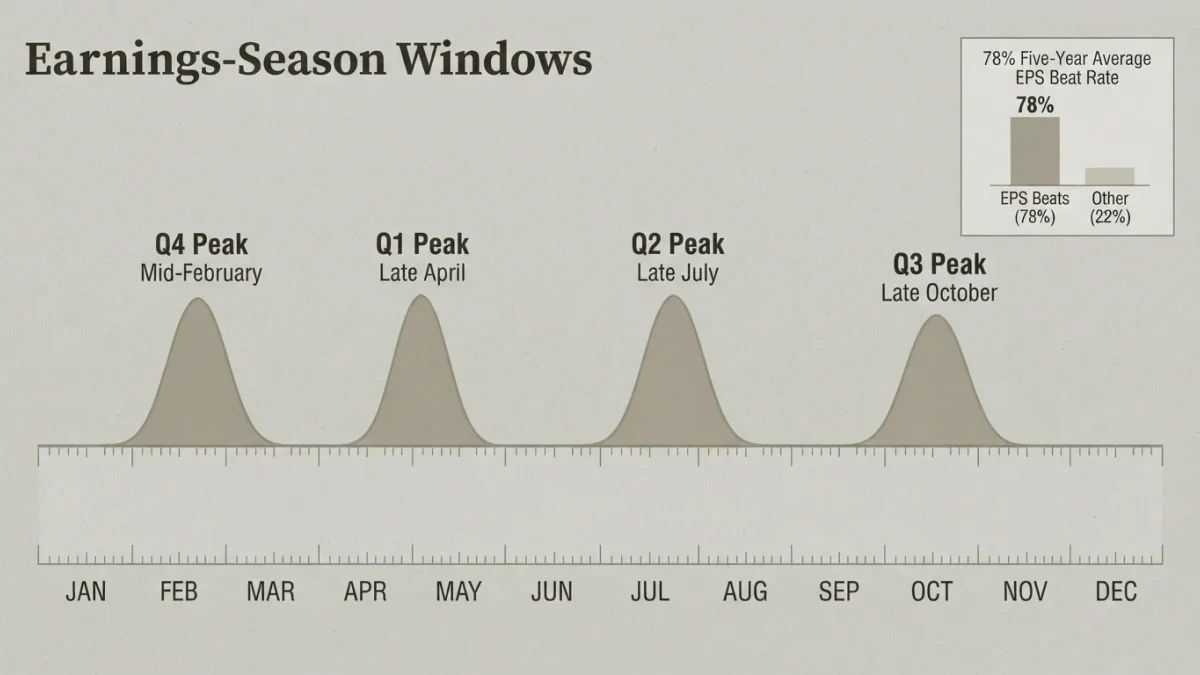

Biotech earnings season is the quarterly window, clustered in late January, April, July, and October, when listed companies report revenue, profit or loss, and pipeline progress for the closed quarter. Roche reported nine-month sales up 7% at constant exchange rates on October 23, 2025; Novartis reported third-quarter net sales up 7% in constant currencies on October 28, 2025.
What is on the calendar, and why does it cluster?
Large-cap developers of medicines, most of them European or dual-listed, report on a schedule tied to their home disclosure rules. Swiss and German issuers frequently publish an ad hoc announcement under stock exchange rules, as both Roche and Novartis did in October 2025, which obliges immediate dissemination of price-relevant information. U.S. issuers file on Form 10-Q or 8-K within regulatory deadlines, which is why a given season compresses into roughly two weeks per quarter.
The rhythm within the window matters. Sales and profit figures arrive first, on a fixed date announced weeks ahead, followed the same morning by a conference call where management takes analyst questions. Mid-cap and clinical-stage biotechs often stagger their releases to attach data updates, partnership news, or guidance changes to the earnings event, which turns a financial disclosure into a pipeline disclosure as well.
For an industry reader, the useful discipline is to know what is being reported before reading commentary. A nine-month release from a Swiss issuer, like Roche's October statement, is not a full-year result and does not carry full-year audited figures; the same company will file a full-year release in late January with guidance for the next year.
Which numbers in a release actually matter?
Start with sales, always with its currency basis attached. Roche's nine-month headline was 7% growth at constant exchange rates but only 2% in Swiss francs, a five-point gap created by the strong franc, per the company's release. Novartis reported third-quarter net sales growth of 7% in constant currencies and 8% in U.S. dollars, with core operating income up 7% in constant currencies and a core operating income margin of 39.3%, per its release. Reading either number without its basis is a category error.
Second, understand what is excluded from the profit measures. Novartis states plainly in its release that constant currencies, core results, and free cash flow are non-IFRS measures, with an explanation located in its condensed interim financial report. Core operating profit strips out items like impairments and restructuring that the companies regard as non-operational; IFRS net income keeps them. Both figures are legitimate, and the gap between them, when it widens suddenly, is itself information.
Third, read the drivers by named product. Novartis attributed its quarter to priority brands including Kisqali, up 68% in constant currencies, Kesimpta up 44%, Pluvicto up 45%, and Scemblix up 95%, while Roche named Phesgo, Xolair, Hemlibra, Vabysmo, and Ocrevus as its top growth drivers, with pharmaceutical division sales up 9% at constant rates and diagnostics up 1%. Concentration in a few products is the normal state of the industry, and these lists show exactly where it sits.
How should guidance changes be read?
Guidance is the company's own forecast, issued with the full-year results and revised at quarter boundaries, and it is where earnings releases carry the most interpretive weight. Roche's October 2025 release raised its full-year earnings outlook alongside the nine-month figures, an upgrade the company tied to the sales momentum already reported. Novartis reaffirmed its full-year 2025 guidance in the same week, with sales expected to grow high single digits and core operating income expected to grow low teens.
The categories of movement are few: raised, reaffirmed, or lowered, each with a stated reason. The reason deserves more attention than the direction. An upgrade driven by volume in named products says something different from one driven by a one-time item or currency assumption, and a lowered outlook that cites a delayed milestone rather than a demand change reads differently for the pipeline.
A useful check on any guidance discussion is the free cash flow line. Novartis reported third-quarter free cash flow of 6.2 billion U.S. dollars, up 4%, on higher operating cash flows, per the release. Cash generation corroborates the income statement in a way that adjusted profit measures cannot, and for clinical-stage biotechs without revenue, the cash runway, typically stated as quarters or years of funding at current burn, replaces guidance entirely as the number to find first.
How do clinical-stage biotechs report differently?
For a company without an approved product, earnings season has a different grammar. There is no revenue line to grow, so the quarter's financial content is cash position, net loss, and research and development spend, and the operative derived figure is the cash runway, stated or calculated as quarters of funding at the current burn rate. The pipeline section, a set of highlights for a Roche or a Novartis, becomes the entire substantive content, because trial progress is the only thing that changes the company's value between financing events.
The calendar pressure also differs. A clinical-stage biotech's reporting is often timed around data disclosures and regulatory interactions rather than a fixed fiscal rhythm, and the cash runway statement is read against the timeline of the next milestone: a company with two years of cash and a phase II readout in nine months is telling investors it expects the readout to fund what follows, through a partnership, a licensing deal, or a raise on better terms. When that sequencing fails, the same earnings documents carry the restructuring announcements, workforce reductions, and program deprioritizations that mark the industry's downside cycles.
The unprofitable majority of listed biotech therefore treats earnings season as a disclosure obligation with a communications strategy attached, while the profitable minority treat it as the quarterly accounting of a commercial business. Reading a season well means knowing which of the two registers each release belongs to before opening it.
What is the difference between a release and what matters?
The quarterly release is a summary document, and its limits are structural. Figures are rounded, non-IFRS reconciliations are abbreviated with pointers to fuller reports, and pipeline claims are selected highlights rather than an accounting of the whole portfolio. Roche's nine-month release, for instance, lists approvals, positive phase III data, and candidate advancements as highlights, one line each; the underlying trial results live in separate disclosures and, eventually, in publications.
The professional reading habit is therefore to treat the release as an index, not an archive. Each number in it points to a financial report, each pipeline claim points to a data disclosure or regulatory action with its own date, and each guidance statement points to assumptions that the next quarter will test. The companies themselves make this easy: both Roche and Novartis attach their condensed interim reports and presentations to the same morning's publication, and those documents, plus the regulatory filings behind them, are the primary record.
Earnings season rewards preparation over reaction. Knowing a company's reporting calendar, its currency basis, its non-IFRS definitions, and its named growth drivers before the release lands is what lets an industry reader extract the quarter's actual information in the twenty minutes before the call.