
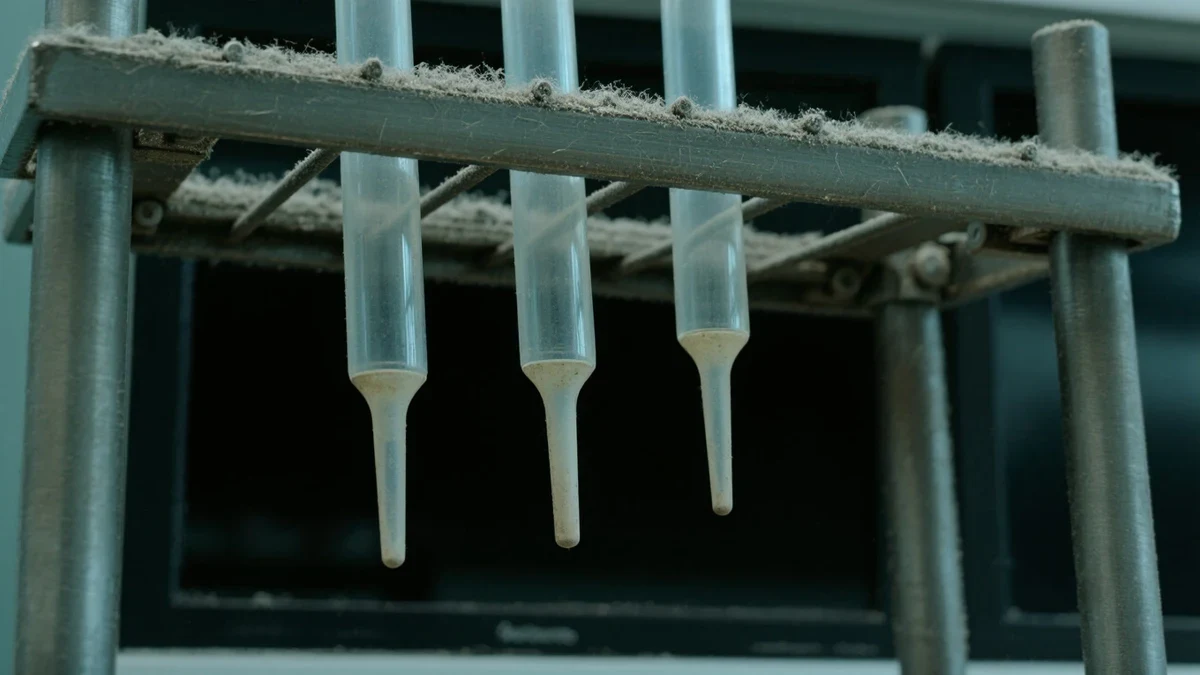
Gene synthesis is the industrial process of building specified DNA sequences base by base, without a natural template. Short fragments are made by phosphoramidite chemistry, assembled into genes enzymatically, and error-corrected before sequencing verification, and in the United States major-provider orders pass a screen for sequences of concern at 50 nucleotides and up, per the HHS framework.
How is a gene actually synthesized?
The workflow is a pipeline, and each stage defines the economics of the product:
- Oligonucleotide synthesis. Short single-stranded fragments, typically under 200 to 300 nucleotides, are built on solid supports by phosphoramidite chemistry, adding one base per cycle with a coupling efficiency that limits practical length.
- Assembly. Overlapping oligos are pooled and joined into longer constructs by methods including polymerase cycling, ligation, or homologous recombination in yeast or bacteria, producing gene-length or even pathway-length DNA.
- Error correction and selection. Mismatches and deletions from imperfect coupling are reduced by error-correcting enzymes and by cloning into bacteria, where a single colony amplifies one molecule into a consistent product.
- Sequence verification. The finished construct is sequenced against the customer's specification before shipment.
- Order screening. Before and alongside production, the provider screens both the customer and the sequence, comparing ordered sequences against regulated agents and broader sequences of concern, as set out in the HHS guidance.
The length limits at stage one explain the industry's structure. Because individual chemical strands cannot be made arbitrarily long, every provider sells assembly as much as synthesis, and price per base falls while accuracy demands rise with construct length. The same limits explain why the 2010 U.S. screening guidance, which asked providers to look for sequences of 200 base pairs or longer unique to regulated agents, matched the technology of its era, per ASPR's summary.
What changed when synthesis got cheap and distributed?
The revision to the screening framework in October 2023 tracked two technology shifts. The first is scale: synthetic DNA became a catalog commodity ordered over the internet by thousands of laboratories, which made per-order screening the only realistic control point. The second is distribution: benchtop nucleic acid synthesis instruments began placing the chemistry itself inside individual institutions, outside the provider-customer relationship on which screening depends, which is why the updated guidance extended recommendations to manufacturers of benchtop equipment and the institutions where such instruments are used, per ASPR.
The 2023 guidance also narrowed the recommended screening window from 200 base pairs to 50 nucleotides and widened coverage to all synthetic nucleic acid order types, single- and double-stranded DNA and RNA. Both changes are direct responses to assembly economics: because short fragments can be assembled into full genes, a screening window longer than the fragments being sold leaves an obvious gap.
A peer-reviewed review in Applied Biosafety documents how the revision was built, through Federal Register comment processes in 2020 and 2022 that drew 15 and 26 unique responses respectively, and notes the executive order that followed, directing agencies to support implementation. The policy, in other words, is tracking a moving technology target, and the screening window is its most quantifiable parameter.
How does screening interact with the technology?
Sequence screening is a database comparison problem layered onto the production pipeline. Each ordered sequence is checked against lists of regulated pathogen sequences and, under the expanded definition, sequences of concern that contribute to pathogenicity or toxicity whether or not they come from regulated agents, per the guidance summary. Customer screening runs in parallel: providers verify who is ordering, as the 2010 guidance already required when it called on suppliers to vet buyers and sequences together, as CIDRAP reported at the time.
The hard cases come from the technology's own strengths. Novel sequences that do not match any listed pathogen, fragments split across multiple providers, and orders below the screening window are all structurally harder to catch, and function-based rather than match-based screening remains an active research direction. The guidance's expanded definition of sequences of concern is a step in that direction, but its implementation still runs on comparison against defined lists.
For customers, the practical consequence is that ordering a gene now involves a compliance surface. Institutions are asked to handle sequences of concern responsibly, including their use and transfer, and a flagged order triggers follow-up questions from the provider before anything ships. Delay, not refusal, is the normal outcome of a screen hit that resolves.
How accurate is synthesized DNA, and why does length cost more?
Accuracy is the quiet constraint running through the entire pipeline. Chemical synthesis adds bases cyclically, and each cycle is imperfect, so the probability that any individual molecule is error-free falls as the sequence gets longer. That is the arithmetic behind the industry's structure: providers sell short fragments with high per-molecule fidelity, then spend assembly, error correction, and bacterial cloning recovering full-length accuracy for longer constructs, and they price by the base with steep surcharges for length, complexity, and difficult sequence content such as repeats or extreme base composition.
Customers feel the same arithmetic from the other side. A gene that arrives sequence-verified on the first attempt is a commodity purchase; a construct with repeats or high GC content can require provider redesign iterations, codon changes that do not alter the protein, or acceptance of a smaller usable fraction of delivered material. Delivery formats carry their own choices, linear fragments versus cloned plasmids, and propagation strains chosen for construct stability.
None of this alters the screening relationship: whatever the accuracy tier or price, the order itself passes the same customer and sequence checks described in the framework. The two layers of the technology, the chemistry that makes the molecule and the screen that gates the order, are independent by design.
What do customers actually receive, and what does it not mean?
The deliverable is verified, sequence-confirmed DNA, typically cloned into a plasmid or supplied as linear fragments, with accuracy specifications stated by the provider. What a customer does not receive is biological function. A synthesized gene is a starting material for research, not a therapy, and the distance from an ordered sequence to a clinical intervention runs through expression studies, efficacy testing in models and trials, manufacturing development, and regulatory review. The gap between the catalogue page and the clinic is measured in years and is bridged only occasionally, by any given sequence.
The honest summary of the field for an industry reader is that gene synthesis is mature infrastructure. The chemistry is decades old, the assembly methods are competitive and improving, and the screening layer is the part still being actively renegotiated between companies, governments, and researchers. Any laboratory that can order a reagent can order a gene; what the ecosystem is still standardizing is what gets checked, by whom, and at what length, before the gene is made.
Two practical currents are worth tracking as the renegotiation proceeds. First, the buyer side is professionalizing: procurement teams increasingly carry screening requirements in vendor qualification, which converts a public policy framework into enforceable private contracts without any new legislation. Second, the equipment side is where policy has the farthest to reach, since benchtop synthesizers move production into institutions whose internal oversight varies enormously, and the guidance's recommendations for instrument manufacturers and host institutions are the part of the framework with the least settled practice behind it. How those two currents resolve will determine whether the 50-nucleotide standard describes the industry as it is or the industry as a much smaller, better-policed subset of it.