
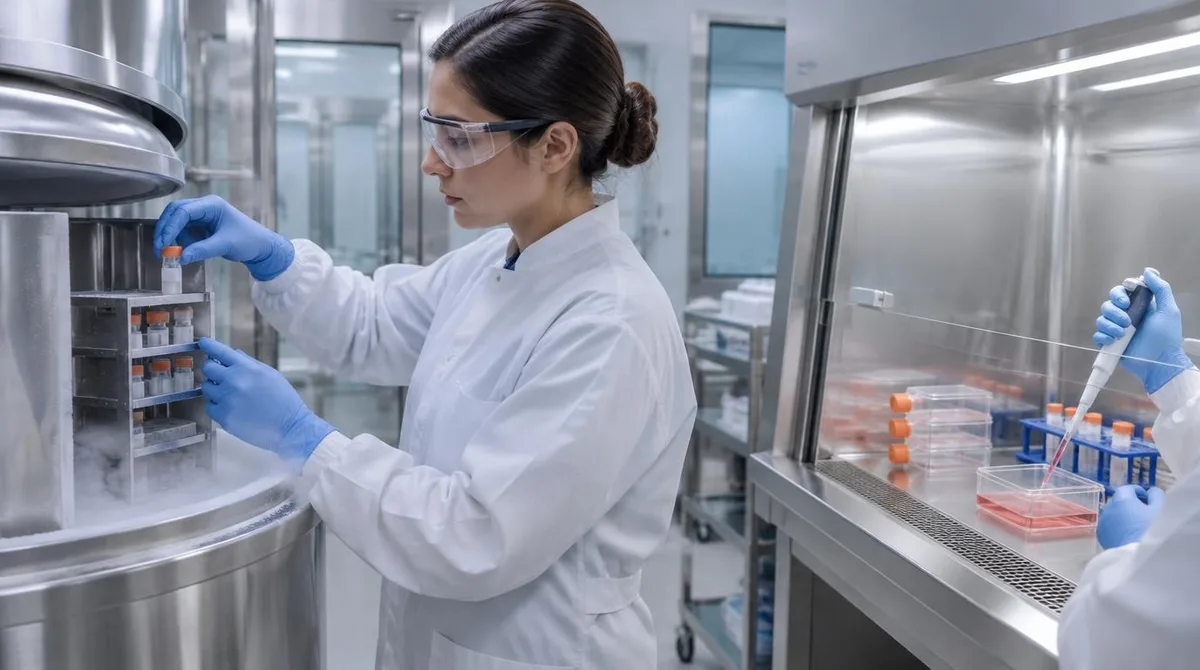
Gene therapy is a treatment approach that works by changing, replacing, or turning off the genes behind a disease, instead of managing symptoms with conventional drugs. Its promise rests on a simple premise: many conditions begin with faulty instructions, so fixing the instructions can address the disease at its origin. Cell therapy technology has become a central way to deliver on that promise, because some of the most advanced gene therapies are made by editing a patient's own cells outside the body and returning them.
The field is still young, and the gap between what works in a laboratory and what works in a clinic remains wide. But the building blocks are now well understood. Genes carry the instructions a body uses to make proteins, and per the National Human Genome Research Institute, humans have approximately 20,000 protein-coding genes — all encoded by roughly 1.5% of the entire genome. Changing even one of those instructions can change how a cell behaves, which is exactly what gene therapy sets out to do.
What is gene therapy, exactly?
Gene therapy is any technique that treats disease by altering genetic material inside a person's cells. To see why that can work, it helps to start with what a gene does. According to Cleveland Clinic, genes give the body instructions to make proteins, telling the cell's machinery which amino acids to use, and where in the DNA to start and stop making each protein. Proteins then build and run nearly every part of the body.
When a gene carries a harmful change — a mutation — the instructions can go wrong. As Medical News Today explains, changes in genes can lead to mutations that cause genetic disorders such as sickle-cell anemia and Huntington's disease, and because genes pass from parents to children, these conditions tend to run in families. Gene therapy aims at those faulty instructions directly. Depending on the disease, the strategy is to add a working copy of a gene, silence a gene that is doing harm, or edit the faulty sequence itself.
The Human Genome Project, completed in 2003, laid much of the groundwork. The effort mapped the entire human genome and, per Medical News Today, identified more than 1,800 genes that can cause disease and made more than 2,000 genetic tests available. Knowing which gene is broken is the first step toward treating it.
Why delivery is the hardest part
Genes are big, and cells do not accept new genetic material on request. Every gene therapy faces the same practical problem: how to get the corrective genetic payload into the right cells, in enough copies, without triggering an immune reaction. This is the delivery challenge, and it is where most of the field's engineering effort goes.
The main routes are in vivo and ex vivo. In an in vivo approach, the therapeutic genetic material is delivered directly into the patient's body, usually carried by a vector — most often a modified virus, engineered so it can enter cells but cannot replicate. In an ex vivo approach, cells are removed from the patient, modified in the laboratory, and infusion-returned as a manufactured product. That second route is where cell therapy technology and gene therapy converge: the patient's own cells become the vehicle, and the manufacturing suite becomes part of the treatment.
Ex vivo manufacturing is demanding. Each batch is a biological product built from living cells, with limited shelf life and tight handling requirements. For readers who want the operational detail, Dark Biotechnology has covered how cell and gene therapies are manufactured at commercial scale, a process that looks more like specialized logistics than traditional pharmaceutical production.
How editing changed the toolkit
Early gene therapy mostly added genes. Newer tools edit the genome itself, cutting out or correcting faulty sequences at precise locations. CRISPR-based systems have driven that shift, and the field has since moved toward methods that make changes without fully cutting the DNA double strand — base editing and prime editing among them, which Dark Biotechnology explains in its guide to how CRISPR moved past the break. This connects to our earlier piece, Base Editing and Prime Editing: How CRISPR Moved Past the Break.
Editing a patient's own cells ex vivo has become the clearest proof of concept for the combined approach. A patient's blood cells are collected, edited to correct the disease-causing sequence, screened for quality, and returned. The edited cells then persist and produce the corrected protein the patient's own genome could not. The same logic extends to edited cell products grown from donor material, which raises different immune questions that trials are still sorting out.
What this means for patients is that the treatment is personal by design. The product is made from — or matched to — the individual, which changes everything downstream: dosing, manufacturing, cost, and the evidence regulators need to see.
How regulators weigh gene therapies
Gene therapies sit in a regulatory category of their own because their effects can be permanent. A small-molecule drug wears off; a corrected gene does not. Regulators therefore look not only at whether the therapy works, but at how long the effect lasts, where in the body the genetic change ended up, and whether it passed to cells that were never intended targets.
In the United States, gene therapies and gene-edited products move through the standard pathway — preclinical work, an investigational new drug application, clinical trials, then review — with additional considerations tied to the durability and heritability of genetic changes. Dark Biotechnology covers the framework in detail in its explainer on how gene-editing therapies are regulated in the United States. The same documentary logic applies across the field: what the agency did, on what date, per which document, with no speculation about decisions still pending.
Real-world examples are now accumulating. Vertex's Casgevy, a CRISPR-based therapy for sickle-cell disease, has begun generating clinical data in younger age groups — Dark Biotechnology reported the first data in children ages five to 11 presented at ASH — and early-stage companies continue to clear the investigational threshold, as with GenEditBio's IND clearance for a gene-editing candidate in corneal dystrophy. Readers following this should also see Vertex Presents First Casgevy Data in Children Ages Five to 11 at ASH.
What the pipeline trend shows
Three patterns define the current pipeline. First, indications are broadening from rare single-gene diseases toward more common conditions, as delivery methods improve and the cost curve of editing tools falls. Second, ex vivo cell-based products are leading, because they let manufacturers verify the edit before the cells go back into a patient. Third, precision is rising: newer editing systems make smaller, more controlled changes, which regulators can evaluate with more familiar tools.
Our analysis: the binding constraint is no longer the science of editing itself. It is delivery, manufacturing scale, and the economics of products built one patient at a time. The field's next phase will be decided less by what editors can do in a dish and more by who can produce, verify, and distribute edited cells at population scale.
What remains unknown
The evidence so far establishes the mechanism — that genetic material can be delivered, edited, and made to change a disease course — and a growing set of regulatory precedents. What remains open is durability over decades, long-term safety outside trial follow-up windows, and whether manufacturing can scale without costs that limit access. None of those questions has a settled answer yet, and honest coverage of the field keeps that gap in view rather than blurring it.