Total laboratory automation integrates a clinical laboratory's pre-analytical, analytical, and post-analytical phases into connected tracks and systems, per a 2025 review in the Annals of Laboratory Medicine. The review names Abbott, Roche, Siemens, and Beckman Coulter as the companies dominating the global TLA market, and its evidence base now includes measured results: a 2026 implementation study reports turnaround-time compliance for hematology rising from 82.0% to 95.2% one year after track installation.
What Is Total Laboratory Automation?
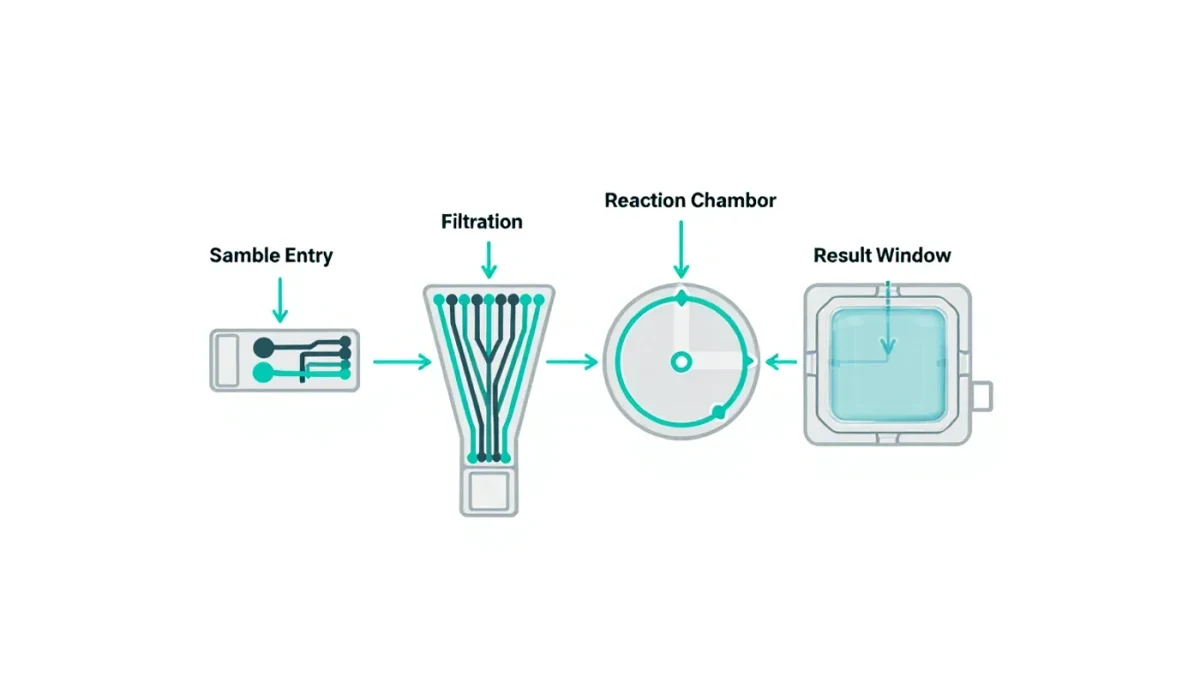
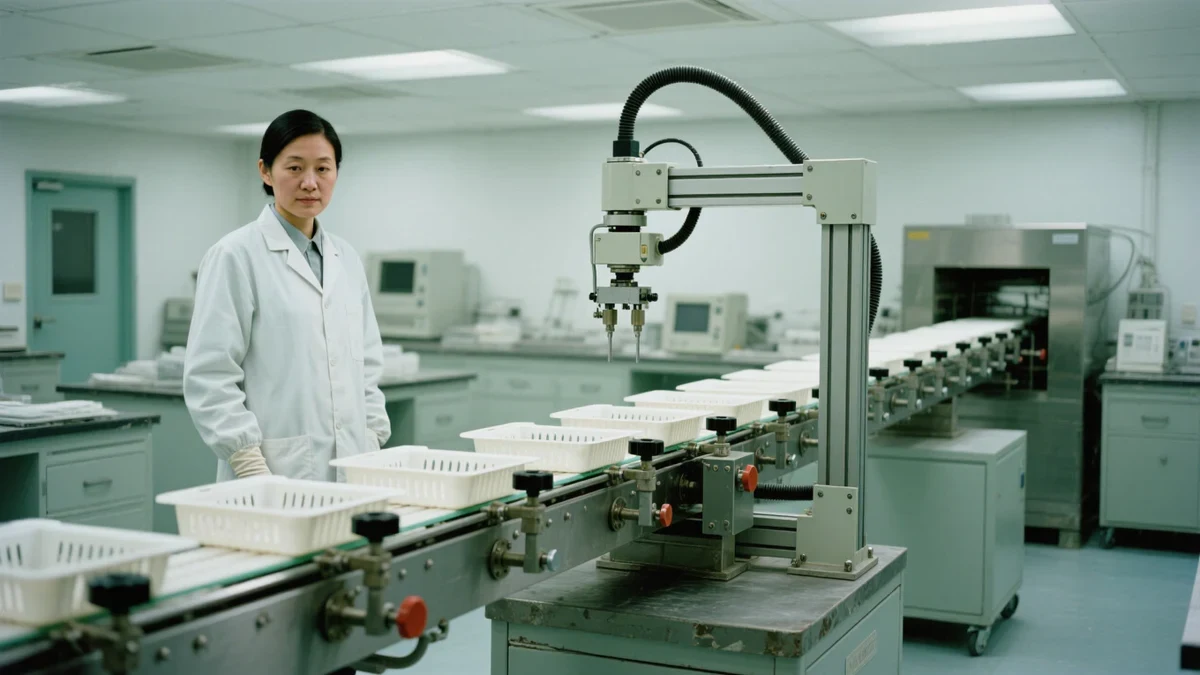
The Annals of Laboratory Medicine review defines TLA as a solution addressing growing demands for operational efficiency, accuracy, and rapid turnaround times in patient care, integrating advanced technologies across the pre-analytical, analytical, and post-analytical phases to streamline workflows, reduce manual intervention, and enhance quality control. The review attributes adoption to increasing test volumes, cost reduction and regulatory compliance pressure, and labor shortages. In physical terms, a TLA installation is a track system that carries sample tubes from sorting through centrifugation and analysis to storage, with analyzers from one or more vendors docked along the line. The device category is the track, the interfaced analyzers, and the middleware that routes every tube.
What Did a Real Implementation Measure?
A 2026 study in Clinical Laboratory evaluated a hematology and coagulation TLA integration at Taichung Veterans General Hospital, where analyzers have been integrated with an Abbott GLP SYSTEMS TRACK since October 2023. The published study reports that turnaround-time compliance improved from 82.0% to 95.2% for hematology and from 76.9% to 93.0% for coagulation one year after implementation. Monthly blood collection tube consumption decreased by 2,915 units, which the authors price at 437 US dollars of savings and 32 kg CO2e of avoided emissions, and the system eliminated manual specimen transport, saving one full-time-equivalent staff position. The study's authors note that future work should focus on long-term sustainability and clinical outcomes.
What Are the Device Layers in a TLA System?
An automation line is assembled from distinct device classes, each with its own vendors and validation burden.
| Layer | Function | Phase served |
|---|---|---|
| Sorter and aliquoter | Routes and splits incoming tubes | Pre-analytical |
| Centrifuge on track | Prepares serum and plasma | Pre-analytical |
| Analyzer line | Performs the measurement | Analytical |
| Storage and retrieval | Archives tubes for add-ons | Post-analytical |
| Middleware | Routes tubes and autoverifies results | All phases |
The review emphasizes that integration across these layers, rather than any single instrument, is what produces the efficiency gains. System integration complexity is likewise listed among the technology's open challenges.
What Does Implementation Require?
The review is candid about the cost side, and the implementation path is a project with laboratory-wide blast radius.
- Map current workflow volumes and turnaround targets against automation capacity.
- Select track architecture and confirm analyzer interface compatibility.
- Rework the physical laboratory around the track footprint.
- Validate routing rules, autoverification limits, and failure modes.
- Retrain staff for exception handling rather than routine handling.
- Monitor turnaround compliance, error rates, and downtime against baseline.
The 2025 review lists high implementation costs, workforce training needs, cybersecurity concerns, and system integration complexities as the standing challenges. The measured benefits arrive only after the validation work is complete.
Where Is the Category Heading?
The review describes recent developments incorporating artificial intelligence, machine learning, robotics, and Internet of Things technologies that enable predictive analytics and automated data management, with future trends pointing toward enhanced AI integration, sustainable practices, and big data analytics. The named market leaders and the technology directions come from the review's synthesis, and vendor-specific claims beyond it are not yet disclosed in comparable form. For hospital laboratories, the decision framework is the one the Taichung study models: measure baseline turnaround and cost, implement, and report the delta with its time window. The device category earns its capital case one measured workflow at a time.
What Changed in the Pre-Analytical Phase?
Most of automation's measured value is won before any assay runs. The pre-analytical phase covers everything from tube receipt through sorting, centrifugation, and aliquoting, and it is where manual handling generates mislabeling, missed spins, and temperature excursions. A track system enforces process physically: tubes are identified, routed, and prepared by the same machinery every time, with exceptions diverted to defined stations rather than improvised. The review's framing of error minimization as a core TLA benefit refers to exactly this stretch of workflow. The Taichung implementation, which eliminated manual specimen transport entirely, demonstrates the endpoint of that logic: one full-time-equivalent position reassigned because the hands-on step no longer exists. Post-analytically, automated storage makes add-on testing a retrieval operation rather than a hunt.
How Do Laboratories Justify the Capital Outlay?
The business case is built from the same measurements the Taichung study reports, and its honesty depends on the baseline. Turnaround-time compliance gains, 82.0% to 95.2% for hematology and 76.9% to 93.0% for coagulation in that study, translate into capacity only if the laboratory can act on faster results. Consumable and staffing deltas, 2,915 fewer tubes per month and one full-time-equivalent position saved in the same implementation, are counted against installation, validation, and service contracts over the system's life. The review is explicit that high implementation costs are among the technology's standing challenges, alongside training and integration. Laboratories that model downtime and middleware validation in the total cost reach more defensible decisions. The measured study is the template precisely because it publishes its baseline, its deltas, and its time window.
Vendor service models absorb some of this risk, with response-time guarantees and spare-part logistics priced into contracts. Laboratories weigh those terms as carefully as throughput specifications, because a track is only as available as its support chain.
What Are the Failure Modes?Automation concentrates risk as it concentrates workflow, and the failure modes are well characterized. A track stoppage idles every docked analyzer at once, so downtime and recovery procedures carry more weight than in standalone-instrument laboratories. Middleware misconfiguration can route tubes to the wrong assay or autoverify results outside intended rules, which is why validation covers the logic layer and not only the hardware. Cybersecurity appears on the review's challenge list, a consequence of connected systems sitting inside hospital networks. Integration complexity compounds when analyzers from multiple vendors dock one line, each with its own interface behavior. None of these are arguments against the technology; they are the maintenance obligations that come with it.
Regulatory treatment follows the device, not the installation. Track components and interfaced analyzers each carry their own clearances and classifications, and laboratories assembling a line from multiple vendors hold the integration evidence that ties the system together for inspection purposes.
How Does the Category Sit Among Other Lab Devices?Total automation is one point on a spectrum of laboratory devices, and most laboratories occupy points between. Standalone analyzers with autoverification deliver much of the error reduction without a track. Modular pre-analytical自动化 systems automate sorting and centrifugation only, fitting laboratories whose constraint is front-end handling. Point-of-care instruments sit at the opposite end, trading central volume for proximity to the patient. A track makes sense where volume is high and sustained, which is why the large reference laboratories and big hospitals anchor the market the review describes. The device decision follows the workflow arithmetic, not the technology ceiling.