
Point-of-care testing is diagnostic testing performed at or near the patient, in a physician's office, clinic, or emergency room, rather than a central laboratory, and its legal boundary in the United States is set by CLIA. The FDA categorizes tests as waived, moderate, or high complexity; only waived tests run in Certificate of Waiver settings, per the agency.
What makes a test a point-of-care test?
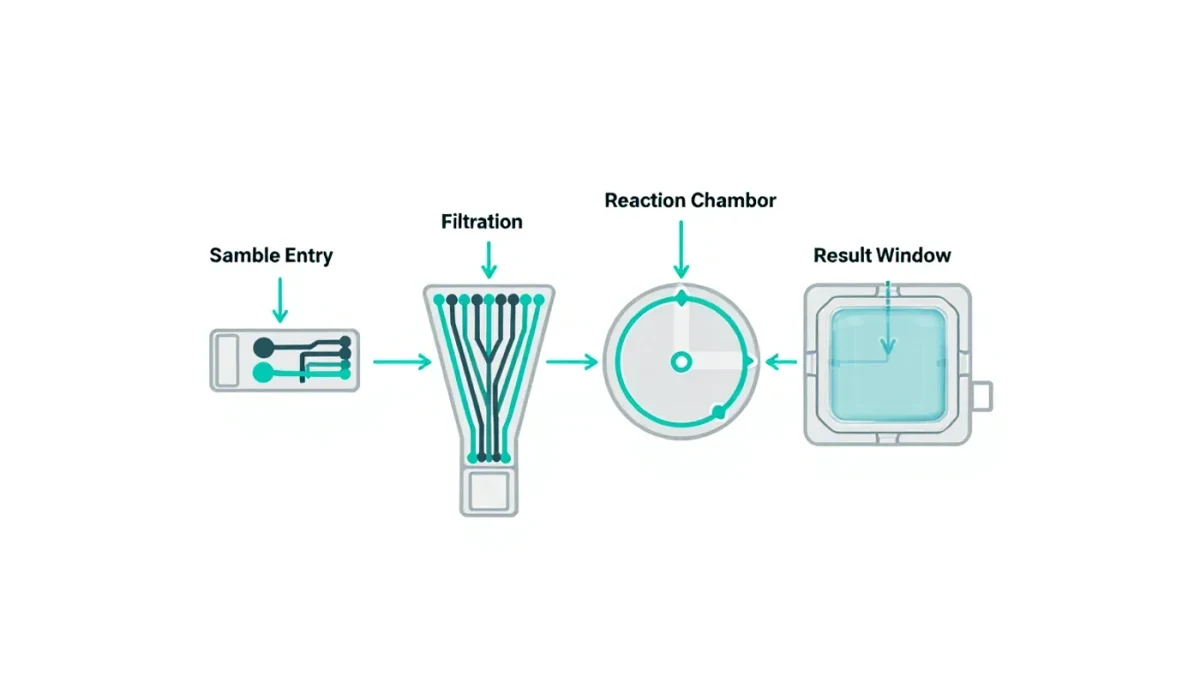
Three properties define the category operationally. The test must be simple enough for a non-laboratorian to run, fast enough to inform the same clinical encounter, and self-contained enough not to need laboratory infrastructure for sample processing. Lateral-flow antigen tests are the familiar case, but the frontier of the category is molecular: Roche's cleared Bordetella assay delivers PCR-technology results in about 15 minutes on the cobas liat system in general practitioner practices and emergency rooms, according to the company's December 2, 2025 announcement.
Sample preparation is frequently the hard part, not detection. Co-Diagnostics announced in October 2025 that it had developed a proprietary sample preparation instrument for its point-of-care tuberculosis test, engineered for low-cost, user-friendly processing in resource-limited settings, supporting both sputum and tongue swab collection, with single-button operation and a built-in safety feature that inactivates live organisms to protect operators, per the company. The design goal the company stated is decentralizing PCR out of roughly 1,000 district hospitals and toward nearly 30,000 primary health centers in India that currently perform microscopy.
The category also includes instruments masquerading as appliances: handheld meters, cartridge-based analyzers, and benchtop systems that walk the user through steps a technician once performed. What unifies them is the regulatory question of who is allowed to run them, which CLIA answers by category.
How does a test earn a CLIA waiver?
The pathway is documentary and evidence-based, and it runs through the FDA:
- Clearance or approval. The test is cleared through 510(k) or approved through a premarket approval application on its analytical and clinical performance.
- Complexity categorization. Tests waived by regulation under 42 CFR 493.15(c), or cleared or approved for home use, are automatically categorized as waived; others are categorized moderate or high complexity under the criteria of 42 CFR 493.17, per the FDA.
- CLIA Waiver by Application. A manufacturer of a moderate-complexity test may submit a CW application asking FDA to categorize the test as waived, providing evidence that it meets the statutory criteria.
- Statutory standard. The statute, which the FDA quotes directly, requires that waived examinations be simple laboratory procedures with an insignificant risk of an erroneous result, employing methodologies so simple and accurate as to render the likelihood of erroneous results by the user negligible.
- Waived categorization. If granted, the test may be performed under a Certificate of Waiver or Certificate for Provider Performed Microscopy, in addition to other CLIA certificate types.
Manufacturers sometimes file the 510(k) and the waiver application together, a dual submission, so that clearance and waived categorization arrive together and the launch can target near-patient settings from day one. The waiver evidence burden is what pushes developers toward forgiving workflows: locked cartridges, automated steps, and internal controls that catch operator error rather than trusting technique.
Why is the waiver the commercial hinge?
Venue volume. Central laboratories number in the thousands; Certificate of Waiver sites number in the hundreds of thousands across U.S. physician offices, clinics, and other settings. A test limited to moderate-complexity settings sells instruments to labs; a waived test sells consumables to every examination room with a certificate. That asymmetry explains why companies invest in waiver-grade evidence packages and why Roche paired its Bordetella clearance with a waiver and CE IVDR certification in a single announcement.
The clinical argument runs alongside the commercial one. Roche framed its test against a diagnostic gap: early pertussis symptoms are often indistinguishable from other respiratory illnesses, and the lack of rapid, accessible diagnostics causes clinicians to treat based on symptoms, with the company citing an estimated 24.1 million cases and 170,000 deaths annually from pertussis. A same-visit molecular answer changes that decision, and only a waived test reaches the settings where most of those decisions are made.
For infectious disease specifically, point-of-care molecular testing also generates geographically dense signal. Co-Diagnostics has described its platform as integrating cloud-based infrastructure with data aggregation intended to help track localized outbreaks as they occur, a surveillance byproduct of distributed testing that central labs, with their transport delays, provide more slowly.
What must a waived site do to stay compliant?
The obligations of the setting itself are lighter than a certified laboratory's, but they are not zero, and they explain part of the category's design. A site performing only waived testing operates under a Certificate of Waiver, which requires enrollment in CLIA, payment of certificate fees on the renewal cycle, and performance of waived tests only, following the manufacturer's instructions exactly as written. The instructions-for-use requirement is the operational heart of the regime: modifications to sample types, timing, or procedure take the test outside its waived categorization, which is why waived products are engineered with locked workflows that make deviation difficult rather than merely discouraged.
The tradeoff embedded in the system is deliberate. Certificate of Waiver sites are not subject to routine proficiency testing or the personnel qualifications of higher-complexity laboratories, which is what allows physician offices to test at all; in exchange, the tests themselves must carry the quality controls internally, and the FDA's waiver standard, insignificant risk of an erroneous result, is the regulatory mechanism that keeps that bargain honest. Every design choice in a waived molecular product, from cartridges to internal controls to single-button operation, exists to satisfy that allocation of responsibility.
For manufacturers, the compliance picture continues after the waiver is granted: labeling changes, new sites of manufacture, and instrument modifications can each raise questions about whether the waived categorization still holds, which is one more reason point-of-care platforms evolve slowly and deliberately compared with laboratory systems that can iterate through software and protocol updates more freely.
What are the limits readers should keep in mind?
Waived does not mean trivial. The category tolerates simple methodologies precisely because the risk of erroneous results must be insignificant, and the FDA's standard is written to keep it that way; complex multiplex panels reach the category only with evidence that untrained operation does not degrade accuracy. Quality management in waived settings is also lighter than in certified laboratories, which is the trade the system accepted in exchange for access.
The second limit is menu breadth. Respiratory and infectious targets dominate waived molecular testing because the clinical urgency justifies the evidence cost; chronic disease markers, complex panels, and quantitative assays remain mostly laboratory territory. The third is cost discipline: near-patient instruments and cartridges must be inexpensive enough for settings without laboratory budgets, which is why companies advertise low-cost instrument and consumable models as a design goal rather than an afterthought.
None of these limits is static. Each newly waived molecular panel lowers the evidentiary and precedential barrier for the next, and the direction of the industry, visible in every clearance-plus-waiver announcement, is toward the examination room.